
Powering Smarter: How One Hidden Technology Is Cutting Industrial Energy Bills – and Strengthening the Grid for Everyone
July 15, 2026
The Problem Nobody Talks About at the Meter
Every month, factories, hospitals, data centers, and large commercial buildings pay more for electricity than their actual energy consumption should require. The culprit is largely invisible—and almost entirely preventable.
It is called reactive power, and it is the silent overhead cost baked into the bills of virtually every facility that runs motors, pumps, compressors, or large air handling equipment. Understanding it, and correcting it, can shave hundreds of thousands of dollars from annual operating budgets while simultaneously reducing stress on the electrical grid that serves your entire community

What Is Reactive Power, and Why Should You Care?
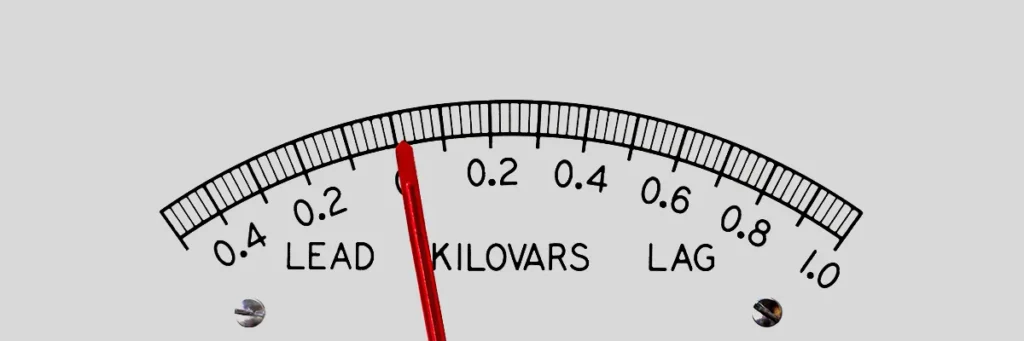
Think of electrical power in two parts, real power and reactive power. Real power (measured in kilowatts, or kW) is the energy that does the useful work—spinning a motor, cooling a building, running a production line. Reactive power (measured in kilovolt-amperes reactive, or kVAR) is the energy that motors and transformers need to create magnetic fields to function. It does not do useful work, but it travels back and forth on the electrical wires, consuming capacity and generating heat in the process.
When a facility draws a lot of reactive power, its power factor—the ratio of useful power to total power drawn—drops. A power factor of 1.0 is perfect. Most large industrial sites operate somewhere between 0.75 and 0.85, meaning that for every dollar of electricity they actually use productively, they are drawing 15 to 25 cents worth of extra capacity from the grid for free, capacity that the utility still must provide, maintain, and in some cases penalize.
The Grid Pays a Price Too
In the PJM Interconnection region—which covers 13 states from Illinois to New Jersey and serves over 65 million people—grid operators require utilities and their customers to manage reactive power responsibly. When facilities do not, the excess reactive demand must be supplied by generators elsewhere on the grid, increasing transmission losses and reducing system capacity.
Those costs do not disappear. They are distributed among all ratepayers through higher transmission rates. In other words, a factory with uncorrected low power factor is, in a quiet and unintentional way, raising electricity bills for its neighbors, its competitors, and every household on the same grid
The Solution: A Small Piece of Equipment with a Big Impact
Power factor correction capacitors are not new technology. They are proven, durable, and widely available. A capacitor bank installed at a facility acts like a local reservoir of reactive power—supplying what the motors need without drawing it from the utility. The result is immediate and measurable:
- Peak demand charges drop because the utility’s meters see less total power drawn from the grid.
- Energy losses inside the facility’s wiring and transformers are reduced because lower reactive current means less heat and less waste.
- Voltage stability improves throughout the building’s electrical system, extending the life of motors and equipment.
- Potential penalty charges from the utility or grid operator are eliminated or significantly reduced.

What Does This Mean in Dollars?
For large facilities, the financial case is compelling and fast. Below is what the numbers typically look like for a mid-size industrial building:
| Financial Metric | Typical Result for a 1,000-kW Industrial Facility |
| Capacitor Installation Cost | $40,000 – $55,000 |
| Annual Demand Savings | $18,000 – $22,000 |
| Annual Energy Savings (losses) | $4,200 – $5,800 |
| Payback Period | 18 – 24 months |
| 15-Year Net Present Value | $180,000 – $240,000 |
| Return on Investment (IRR) | 55% – 88% |
These numbers hold up even under conservative assumptions—higher installation costs, smaller rate structures, or lower-than-expected usage hours. Across all scenarios tested in this analysis, payback remained under 30 months, making this one of the most reliable energy investments available to facility managers today.
Why Bigger Facilities Win the Most
The return on power factor correction does not scale linearly, it accelerates with facility size. The reasons are practical:
- Large facilities pay demand charges in the range of $12 to $22 per kilowatt per month. Even modest demand reductions translate into tens of thousands of dollars in annual savings.
- The engineering and installation overhead is largely fixed. The cost to engineer, permit, and install a system does not double when you double the capacitor size. Per-unit installed cost drops as scale increases.
- Large operations can integrate capacitor switching into their existing energy management systems, automatically adjusting reactive support based on production schedules and grid pricing signals.
Benefits That Extend Beyond the Fence Line
For the Utility and Grid
When facilities correct their power factor, utilities experience reduced reactive demand on their distribution systems, leading to decreased transformer loading and feeder currents. The utility can defer expensive infrastructure upgrades—new substations, conductor replacements, voltage regulator installations—all of which would otherwise be paid for by ratepayers.
Across a utility service territory, a well-designed power factor correction program reduces the Revenue Requirement—the total cost base from which rates are calculated—creating downward pressure on electricity rates for every customer class.
For the Community
Lower system losses mean less electricity must be generated in the first place. Less generation means fewer emissions from power plants, lower fuel consumption, and a more efficient use of the entire energy infrastructure. Power factor correction is not a headline-grabbing clean energy technology, but its aggregate impact on grid efficiency is quietly significant.
What Should Facility Managers and Energy Leaders Do?
- Audit your current power factor. Request 12 months of utility bills or interval data and calculate average and peak power factor. If it falls below 0.90, you have an immediate opportunity.
- Engage a qualified electrical engineer to conduct a harmonic study. In facilities with variable frequency drives (VFDs) or other non-linear loads, standard capacitors can create resonance problems. Harmonic filters may be required—and they enhance the investment further.
- Check your utility’s incentive programs. Many utilities in PJM territories, including ComEd, offer custom measure incentives for demand reduction projects. Power factor correction frequently qualifies and can recover 20% to 30% of installed cost through utility rebates.
- Integrate correction into your strategic energy plan. Power factor correction is not a one-time tactical fix. Managed properly, it is a component of a long-term Strategic Energy Management (SEM) platform that continuously optimizes electrical system performance alongside lighting retrofits, motor upgrades, and compressed air optimization.

Conclusion
Power factor correction through capacitor installation is one of the highest-return, lowest-risk energy investments available to industrial and commercial facilities today. It reduces bills, extends equipment life, strengthens the electrical grid, and benefits every ratepayer on the system.
The technology is proven. The economics are favorable across a wide range of scenarios. The grid benefits are real and measurable. The only question remaining for most facility operators is not whether to act—but when.
The answer, according to the data, is now.
Written By Senior Engineer, Khaleel Alaloosi
Related Posts

ES Leak Surveys: Low Commitment, High Savings
Compressed air systems are often one of the most expensive utilities in a facility, and leaks can account for a significant amount of wasted energy. A compressed air leak...

ASHRAE Audits: A Practical Guide to Smarter Energy Decisions
As energy costs rise, building systems become more complex, and efficiency standards continue to evolve, organizations are looking for clear, more reliable ways to understand how their facilities are...

Illuminating Energy Savings
The complex landscape of energy efficiency is constantly developing according to research, experience, and best practices that are shared industry wide. As such, there are a number of moving...
Leveraging Downtime and Funding to Optimize Compressed Air Systems
In the steel blanking industry, wherein flat, geometric shapes are created by feeding a coil of sheet metal into a press and die, compressed air is often referred to...

Solar Inspections for Safe and Optimal Operation
Solar inspections play an important role in ensuring systems are installed correctly, operate safely, and continue to perform optimally over time. As solar projects continue to expand across the...

Sustainability Planning
In recent years, sustainability has become a cornerstone of organizational planning. Taking into account the economic, social, and environmental impacts of the actions taken by businesses and municipalities, sustainability...