

Energy Saving Opportunities with Industrial Systems: Dry Coolers
October 14, 2026
In our previous article in this series, Energy Savings Opportunities with Industrial Systems – Process Cooling, we listed Dry Coolers as one of the highly effective energy savings measures that can save substantial energy in cooling systems. Due to its gaining popularity as an effective technology for industrial cooling, in this article we’ll dive deeper into what dry coolers are, how do they fit in a cooling system, how do they save energy, and go over some sample calculations/case studies.
Industrial process cooling has historically relied on two primary workhorses: mechanical chillers and evaporative cooling towers. However, as facilities face rising energy costs, stricter environmental regulations, and growing water scarcity, a third technology has rapidly gained market share: the dry cooler.
What is a Dry Cooler?
A dry cooler is a closed-loop heat exchanger that cools a fluid (usually water or a water-glycol mixture) by passing ambient air across a finned tube coil.
Unlike evaporative cooling towers, which cool water by exposing it directly to the air and utilizing the latent heat of vaporization (evaporation), dry coolers rely entirely on sensible heat transfer. Because the process fluid never comes into contact with the air, there is no water consumption, no need for continuous chemical water treatment, and no risk of biological contamination like Legionella.
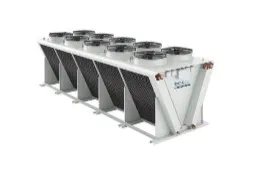
A V-bank Industrial Dry Cooler. Image Source: Enex Industrial
Components and Configuration
While they appear similar to the condenser section of an air-cooled chiller, dry coolers are standalone units built from a few critical components:
- Heat Exchanger Coils: The core of the unit is a dense network of tubes and fins. Traditionally, these are constructed with copper tubes and aluminum fins. However, many modern units utilize microchannel aluminum coils. Micro-channel coils offer superior heat transfer coefficients, weigh less, and drastically reduce the internal fluid volume required, which lowers the cost of glycol antifreeze.
- Fans and Motors: The airflow is driven by an array of axial fans. The industry standard has shifted from traditional AC induction motors to EC (Electronically Commutated) fans. EC motors feature integrated variable frequency drives (VFDs) that allow for seamless speed modulation. Because fan power follows the affinity laws, reducing fan speed yields exponential energy savings.
- Enclosure and Geometry: Casings are typically made of heavy-gauge galvanized steel treated with epoxy or polyurethane coatings to resist environmental corrosion. Geometrically, they come in two main styles: flatbed and V-bank. In flatbed configuration, the fluid moves horizontally from right to left and the air drawn from the bottom is pushed out upwards. V-bank configurations angle the coils into a “V” shape making the fluid pass from top to bottom and the air is drawn from the sides, packing significantly more heat transfer surface area into a smaller physical footprint. But V-bank dry coolers tend to be more expensive than flatbed dry coolers.
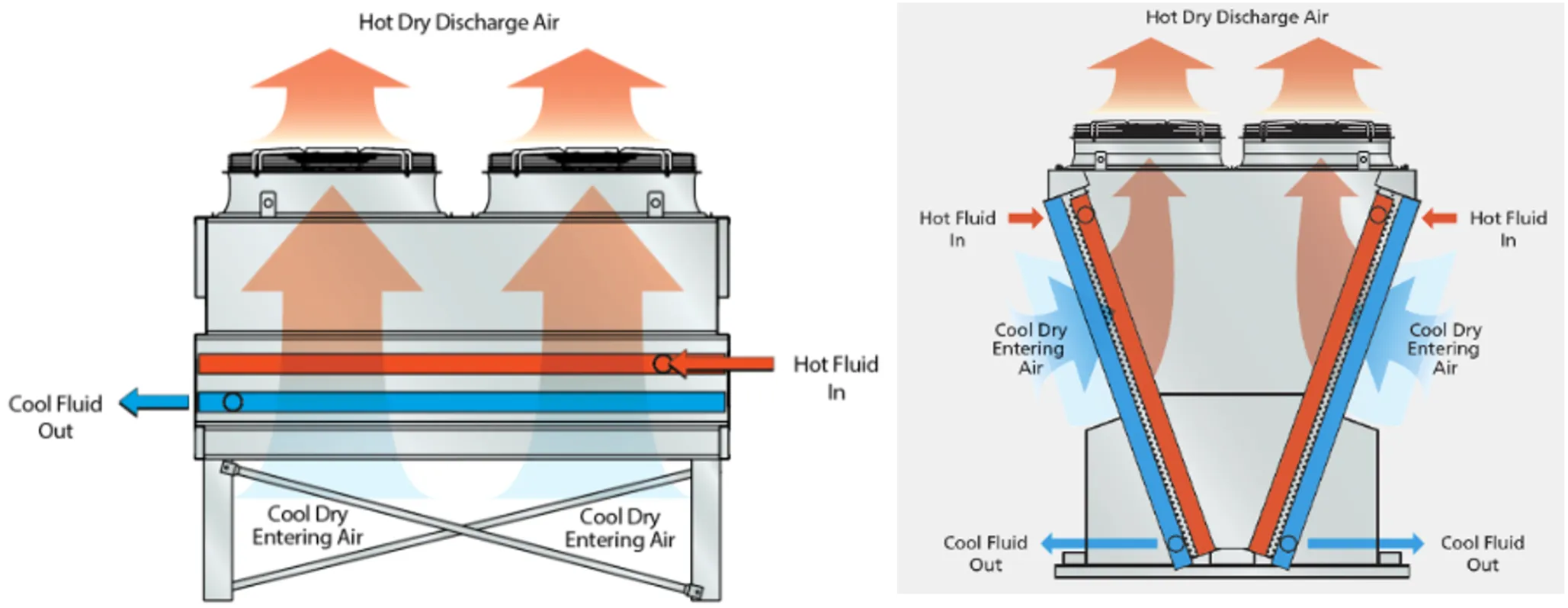
Flatbed (left) vs V-bank (right) configuration dry coolers. Image source: EVAPCO
System Integration
Dry coolers are rarely the sole source of cooling for an industrial facility year-round; they are usually integrated alongside mechanical chillers to handle the load during colder months. Because dry coolers sit outdoors in sub-freezing temperatures, the fluid inside them must be protected from freezing. This is typically achieved by running a 30% to 40% propylene or ethylene glycol solution through the outdoor loop. To keep glycol out of the indoor process equipment, the system is divided by a Plate and Frame Heat Exchanger.
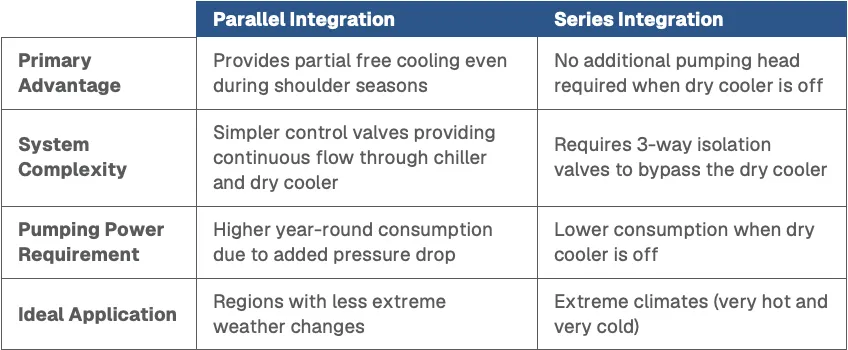
There are two primary integration strategies: Parallel Integration and Series Integration.
Parellel Integration (Standalone Operation)
In this setup, the dry cooler and the chiller are piped in parallel. When the outdoor temperature drops low enough, the chiller is isolated via automated control valves and shut down entirely. The dry cooler takes over 100% of the cooling load.
Series Integration (Pre-Cooling)
In a series configuration, warm return water from the process passes through the dry cooler before entering the chiller’s evaporator. If the ambient air is cold, but not quite cold enough to handle the entire load, the dry cooler acts as a first stage. It strips heat out of the fluid, lowering the entering water temperature to the chiller and reducing the mechanical compressor load.
How Dry Coolers Save Energy
The energy savings from a dry cooler stem from a simple substitution: trading compressor horsepower for fan horsepower. Mechanical chillers rely on the refrigeration cycle. Compressors are energy-dense, high-amperage components. An industrial air-cooled chiller operates at a minimum efficiency of roughly 1.0 to 1.25 kW/ton, per ASHRAE 90.1.
A dry cooler, by contrast, only uses electricity to spin its fans. At full speed, a dry cooler might use 0.25 to 0.3 kW/ton. The thermodynamic capacity of a dry cooler is governed by its Approach Temperature—the difference between the leaving fluid temperature and the entering ambient dry-bulb temperature.
If a process requires 60°F cooling water and the dry cooler has a 10°F approach, the unit can provide 100% “free cooling” whenever the outdoor ambient temperature drops below 50°F. As the ambient temperature drops further, the EC fans modulate down. According to the fan affinity laws, the power consumption P varies with the cube of the fan speed N:
If the fans slow down to 50% speed, they consume only 12.5% of their design power, pushing the efficiency to a staggering 0.03 kW/ton.
Ideal Climates and Application
Because dry coolers rely on sensible heat transfer, their capacity is dictated entirely by the dry-bulb temperature of the ambient air. (Unlike cooling towers, which are driven by the wet-bulb temperature). Therefore, dry coolers provide the fastest ROI in cold and temperate climates—such as the American Midwest, Canada, and Northern Europe.
Market Adoption
The adoption of dry coolers and dry cooling systems has accelerated significantly in recent years, driven by a global shift toward water conservation and energy efficiency. Market data from 2024 through early 2026 shows steady, robust growth across multiple industrial and commercial sectors.
Depending on the specific market report and the scope of equipment included (e.g., standalone modular units vs. large-scale industrial arrays), the global dry cooler market was valued between $2.28 billion and $4.19 billion in 2024 and is projected to expand at a Compound Annual Growth Rate (CAGR) of 5% to 6.2% over the next decade.
Primary Growth Driver
Three major forces are pushing facilities away from traditional evaporative cooling towers and mechanical chillers toward dry cooling:
- The Data Center Boom: The rapid expansion of cloud computing, artificial intelligence (AI), and high-performance computing has placed immense pressure on data center infrastructure. Facilities must dissipate massive heat loads without exhausting local water supplies. Dry coolers are increasingly integrated into these thermal management strategies to provide reliable heat rejection with zero water consumption.
- Water Scarcity and Regulation: In regions facing drought conditions or strict municipal water-use regulations, the continuous water makeup required by evaporative cooling towers is becoming a massive operational liability. Dry coolers eliminate water usage, chemical treatment, and the risk of biological contamination (like Legionella), making them highly attractive for risk mitigation and environmental compliance.
- Industrial Process Cooling: In manufacturing sectors—such as chemicals, pharmaceuticals, food processing, and plastics manufacturing (including hydraulic and hybrid injection molding)—facilities are increasingly focused on reducing their Specific Energy Consumption (SEC) and lowering their carbon footprint. Dry coolers provide a pathway to significant energy savings through water-side economization without the overhead of open-loop water systems.
Why Data Centers Prefer Dry Coolers
- Zero Water Consumption: Data centers face immense public and regulatory pressure over water usage, particularly in drought-prone areas. Dry coolers allow massive facilities to operate without consuming millions of gallons of water per year.
- Failsafe Reliability: Dry coolers are mechanically simple—essentially just coils and fans. They have no compressors to fail, no refrigerant circuits to leak, and require less maintenance than cooling towers, which suffer from scaling and require chemical treatments.
- Geographic Flexibility: Because they don’t require a massive municipal water supply, data centers utilizing dry coolers can be built in remote or arid locations where land and renewable power are cheap, but water is scarce.
Engineering Case Study: Injection Molding in the Midwest
Let’s evaluate a hypothetical 24/7 manufacturing facility in the Chicago, IL area that operates several hydraulic injection molding machines.
- Cooling Load: 150 Tons for hydraulic oil heat exchangers.
- Required Supply Temperature: 85°F.
- Chiller Baseline: A standard air-cooled chiller running at an average efficiency of 1.05 kW/ton.
- Dry Cooler: A V-bank unit with 12 EC fans, consuming 18 kW at full design speed (approx. 0.12 kW/ton).
In the Chicago climate, the ambient dry-bulb temperature is below 75°F for approximately 6,300 hours per year (roughly 72% of all hours). During these hours, the dry cooler can handle the entire 150-ton load.
First, we calculate the energy the mechanical chiller would have used during those 6,300 hours:
Echiller = 150 tons x 1.05 kW/ton x 6300 hours = 992,250 kWh
Next, we calculate the energy the dry cooler will use. Because the ambient temperature frequently drops well below 75°F during the winter, the EC fans will modulate down. Assuming an average fan speed of 60%, the power draw is:
Pavg = 18 kW x (0.60)3 = 3.88 kW
Edry_cooler = 3.88 kW x 6300 hours = 24,444 kWh
By bypassing the chiller and relying on ambient air, the facility saves:
992,250 kWh – 24,444 kWh = 967,806 kWh
At a blended utility rate of $0.09/kWh, this translates to $87,102 in annual energy savings, not including the reduction in chiller maintenance and prolonged compressor lifespan.
Summary
Dry coolers represent a highly effective strategy for decarbonizing and optimizing industrial cooling. By separating heat rejection from water consumption and leveraging low ambient temperatures, facilities can significantly reduce their annual energy consumption, their operational expenses and improve equipment life.
Article written by: Karthik Radhakrishnan, Energy Engineer
References:
- ASHRAE 90.1
- Evaluating Process Cooling Supply Temperatures | Chiller & Cooling Best Practices
- Dry Cooler Market Research Report 2033
- Dry Coolers Market Trends, Size & Growth by 2034
- Dry Coolers Market Size, Share, Trends | Report 2035
Related Posts

Industrial Decarbonization
At the 2026 MI Healthy Climate Conference, industrial decarbonization was highlighted as one of the key components in Michigan’s carbon reduction strategy. Reducing the emissions coming out of industrial...
Powering Smarter: How One Hidden Technology Is Cutting Industrial Energy Bills –...
The Problem Nobody Talks About at the Meter Every month, factories, hospitals, data centers, and large commercial buildings pay more for electricity than their actual energy consumption should require. The...

ES Leak Surveys: Low Commitment, High Savings
Compressed air systems are often one of the most expensive utilities in a facility, and leaks can account for a significant amount of wasted energy. A compressed air leak...
ASHRAE Audits: A Practical Guide to Smarter Energy Decisions
As energy costs rise, building systems become more complex, and efficiency standards continue to evolve, organizations are looking for clear, more reliable ways to understand how their facilities are...

Illuminating Energy Savings
The complex landscape of energy efficiency is constantly developing according to research, experience, and best practices that are shared industry wide. As such, there are a number of moving...
Leveraging Downtime and Funding to Optimize Compressed Air Systems
In the steel blanking industry, wherein flat, geometric shapes are created by feeding a coil of sheet metal into a press and die, compressed air is often referred to...